Saturday, April 29, 2006

Merlot Muffins

wine-cake

Though I am fairly certain these would be better classified as cupcakes, I really enjoy alliteration, hence the name. While making the fruit juice bread in my previous post, I was complaining to my mother about the fact that there is beer bread, but no wine bread or cider bread, and she rememebered having had a wine cake years ago. She found the recipe a friend had submitted to a church cookbook -- one of those frighteningly midwestern collections of recipes for meaty cheese dishes and cheesy meat dishes the whole family will love. The recipe called for some cooking sherry and eggs to be added to a yellow cake mix to make a cake with a poundcake-like texture and density.

I decided instead to add some red wine to a delicious, but obnoxious, recipe for yellow cake I recently adapted to make a spiced chai cake for my sister's birthday. It is indeed moist and tasty, as advertised, but it also involves mixing the ingredients for a total of over 15 minutes. I suppose it's not that bad; it's just more work than I'm used to for a cake. All I did to change it was to replace the buttermilk with merlot, then I decided to bake it in muffin cups instead of a cake pan, and I put powdered sugar on top.

They are very good, and were well-liked at my mom's office, where they were brought in on a co-worker's last day. I liked the batter better than the baked cupcakes (isn't that just always the way?) mostly for its stronger wine flavor. I wonder if I made a poor wine choice. I really don't know much about choosing wines, but I thought something medium bodied and fruity would be nice. It might have been better with sherry or even port, or if I'd tried reducing the wine before adding it to the batter.

But that is often my complaint. "More flavor!" Which I think makes me something like the baking version of Tim "The Toolman" Taylor and his constant quest for "more power". Except I grunt less? We hope. Anyway, I am rarely completely satisfied with anything unless it is the life-changing sort of delicious. Fortunately, there are several things I make that I think would fall into that category, so it's not an impossible standard to hold myself to.

Wine Cake
Original recipe from The Well-Decorated Cake, by Toba Garrett

Ingredients
3 cups (330 g) cake flour
1 Tbsp baking powder
1/2 tsp salt
1 cup (8 oz or 230 g) unsalted butter, room temperature
2 cups (454 g) granulated sugar
5 large eggs
2 tsp vanilla extract
1 1/4 cups (10 fl oz or 300 ml) red wine

1. Preheat oven to 350°F (175°C). Butter and line with parchment paper two 8x2-inch (20x5-cm) pans. (Or about 24 muffin cups.) Set aside.

2. In a medium bowl, sift together the flour, baking powder, and salt.

3. Cut up the butter into 1-inch pieces and place them in the large bowl of an electric mixer, fitted with a paddle attachment or beaters. Beat for 3 minutes on MEDIUM-HIGH speed until the butter is light and creamy in color. Stop and scrape the bowl. Cream the butter for an additional 60 seconds.

4. Add the sugar, 1/4 cup at a time, beating 1 minute after each addition. Scrape the sides of the bowl occasionally. Add the eggs one at a time.

5. Reduce the mixer speed. Stir vanilla into the buttermilk. Add the dry ingredients alternately with the wine. Mix just until incorporated. Scrape the sides of the bowl and mix for 15 seconds longer.

6. Spoon the batter into the prepared pan and smooth the top with a knife. Lift up the pan with the batter, and let it drop onto the counter top to burst any air bubbles, allowing the batter to settle.

7. Center the pans onto the lower third of the oven and let bake 45 to 50 minutes (or about 30 for muffins, depending on their size) or until the cake is lightly brown on top and comes away from the sides of the pan and a toothpick inserted in the center comes out clean.

Note: Let the cake cool in the pan. Storage: Double wrap the cake in plastic wrap. It will keep in the refrigerator for up to 2 weeks or in the freezer for up to 2 months.
Yield: Two 8-inch (20-cm) cakes

Monday, April 24, 2006

POM Blueberry Fougasse

berry

When I was still in the process of making these and thinking about the blog entry I'd write for this bread, I figured I'd either start out by declaring myself a baking genius, or saying I'd found out why no one uses fruit juice instead of water in bread. Now that I've made and tasted it, I'm leaning towards the former, but the idea could still use refining.

I got the idea while emailing Lee about making a lean dough version of the coffee rolls below and thinking about the fact that people use things like beer or potato water to make flavored breads (I've even put water from boiling garlic in bread) but you don't really see breads made with fruit juice, even though people put dried fruit in bread, and the juice would combine liquid, sugar, and flavor all together, so it should work well. I decided to try the idea with a recipe for sweet fougasse I'd made before, but wanted to try again with citrus or anise or something in it. I cut back on the amount of sugar to compensate for the extra the juice would add, added some dried fruit, and had to use a little more juice than the recipe called for water to get the same consistency. I used dried blueberries and blueberry pomegranate juice, but I think apple juice or cranberry juice would be nice too, as would most any kind of dried fruit. I wonder how coconut milk would be in bread.

I'm pretty happy with the results. The house smelled amazing while it was baking. It got pretty dark, as is to be expected from all the sugar in it. It is a little more dense than the regular sweet fougasse I made, and it has a nice blueberry flavor. Basically, it tastes like a lighter blueberry bagel (except better). I suppose I only think of it as being like a bagel because that seems to be the only kind of bread people are willing to experiement with. Other breads tend to be the same traditional loaves, but any bagel shop will have dozens of creative and original flavors.

I also just started something new I came across in The Village Baker by Joe Ortiz that I've borrowed from the library. It is a pain aux pommes that takes this idea of a fruit juice bread one step farther by making bread on a paste of fermented apples. It will take about two weeks to make the bread, including time to ferment apple chunks, but I am very excited about it.

Fruit Fougasse Recipe
Adapted from a recipe in Crust & Crumb by Peter Reinhart

Poolish:
4 cups bread flour
4 cups cool water
1/4 teaspoon instant yeast

Combine all ingredients in a bowl and mix until smooth.
Cover with plastic wrap and let sit at room temperature 3~5 hours, until bubbly.
Refrigerate overnight, covered.

Sweet Rustic Bread:
2 cups poolish from above
4 1/2 cups bread flour
2 tablespoons granulated sugar
2 teaspoons salt
1/2 teaspoon instant yeast
2 tablespoons olive oil
1 cup (or more) fruit juice
1.5 oz dried fruit

Confectioner's sugar for dusting
Vegetable oil cooking spray

1. Measure out poolish and let sit at room temperature to take off the chill
2. Combine the ingredients in a bowl.
3. Mix until gluten develops. (The recipe suggests 8 minutes with a dough hook on medium, or two minutes in a food processor, or 15 minutes by hand, which is what I did.) Cover with plastic wrap and let rise at room temperature three hours, or until increases 1 1/2 times in size.
4. The dough will have stiffened somewhat. Scrape it onto a heavily floured counter, flour your hands, and roll the dough around to coat it, kneading gently a few seconds. Form a loose ball and dust with flour. Cover with plastic wrap and let rise at room temperature one hour.
5. Cover three pans with baking parchment (either flat ones, or invert pans with a lip, because you'll want to be able to slide the dough onto a baking stone in the oven) mist the parchment with cooking spray and sprinkle with semolina flour.
6. Flour your hands and the dough, kneading a few seconds. Pat the dough into a disk about 6 inches in diameter, then cut into 6~8 wedges. Dip the knife/pastry blade into cold water between cuts so it doesn't stick.
7. Keeping your hands floured, transfer the cut wedges to the pans, leaving lots of room between them. Don't stretch the wedges. Mist with cooking oil, dust with flour, and let proof at room temperature 2 hours, until wedges have increased in size 1 1/2 times. Refridgerate overnight.
8. Remove the pans from the refrigerator 2 hours before baking and let rise until nearly twice their original size.
9. 40 minutes before baking, preheat oven to 475*F, with a steam pan on the lower rack, and baking stone on the upper.
10. Do not score the wedges. Slide them (and the baking parchment) directly onto the baking stone. Spray wedges and oven walls with water and pour 2 cups hot water into steam pan. Close the oven door, then spray the oven with water again after two minutes. After five minutes, reduce oven temperature to 425*F.
11. Bake the for about 20 minutes, rotating once halfway through for even baking.
12. Once wedges are golden brown, remove from oven and move to a cooling rack.
13. Spray the wedges with cooking oil and dust with confectioner's sugar. Let cool for 40 minutes before eating.

Tuesday, April 18, 2006

Miche / Pain Poilâne

miche

So I finally baked the bread off the cover of The Bread Baker's Apprentice. I'd been sort of lusting after it for a while, reading more about the bakery where it originated, Boulangerie chez Poilâne. Their website, available in English and French, includes a form for ordering loaves to be shipped. What I made would cost me $35.95 to have shipped to my home. I'm not sure how to react to the fact that that doesn't seem excessive for a loaf of bread. I wouldn't eat it every day, certainly, but I'd consider trying it once, even just for the coolness of having bread come in the mail. I also like that their website has food pairing ideas for all their breads.

The bread is a 2kg (~4lb) loaf of very sour, dense, wheat bread. It is essentially the opposite of this pain de campagne I made before. That was a mild whole wheat sourdough starter made with white flour, and this is a fairly acidic white sourdough starter made with wheat bread. Both are delicious (and beautiful) but I think the pain de campagne is a more accessible taste. At least, no one in my family has been making sandwiches on this one. It's also possible they just don't like slicing it though. It is very dense.

I'd been putting off making it because I wanted to do it right. It's just big enough that kneading it is a bit of a challenge, and I wanted a strong sourdough starter. I'm extremely pleased with how it came out though. The book suggested scoring a pound sign on it, but I really liked the stylized 'P' on the real Poilâne loaves, and decided to carve a 'G' on mine for my first initial. (Since a 'K' for my last name wouldn't have looked as nice.) I may have to make that my signature loaf-scoring. It would be nice if I could get good enough at changing the angle of the cuts so that mine looked like calligraphy like theirs do.

The only things I would change if I bake this again would be to dust it with flour to make the scoring stand out more (it looks like they dust at Poilâne, but the cookbook didn't mention it, and the one in their photos aren't floured) and to bake it a bit longer. I pulled mine out at the earliest of the range of baking times, but it was still a little doughy inside. It's possible it's just very dense and is supposed to be like that. I thought a desem-style bread I made recently was underbaked, but I bought one from a local bakery and it had a similar texture. Maybe whole wheat sourdough breads just stay squishy.

One thing I really like about this recipe is that it is apparently too big for most home mixers, even the fancy ones, so even people who have nice things have to do it by hand like I do.

Poilâne-style Miche
Recipe from The Bread Baker's Apprentice by Peter Reinhart

Barm
3 1/2 cups bread flour
2 cups water, room temperature
1 cup sourdough starter

Stir ingredients together, cover with an air-tight seal and let ferment at room temperature 6 hours, or until barm is bubbly. Open to let gas escape, then recover and refrigerate overnight. It will remain active for up to three days.

Firm starter
1 cup barm
2 cups medium grind whole wheat flour
1/2 cup water, room temperature

Stir together the barm, flour, and enough water to make a firm ball of dough. Knead about three minutes, place in an oiled bowl and cover with plastic wrap.

Ferment at room temperature 4~6 hours, or until doubled in size. Refrigerate overnight.

Remove firm starter from refrigerator one hour before making the final dough. Cut into 12 pieces and let sit to take off the chill.

Final dough
7 cups medium grind whole wheat flour
3 1/4 teaspoons salt
2 ~ 2 3/4 cups lukewarm water
semolina flour for dusting

In a large bowl mix flour, salt, and starter pieces. Add at least 2 1/4 cups of water to form a soft ball. Adjust flour and water as needed.

Knead on a floured surface for 12 to 15 minutes, continuing to adjust flour and water as needed. The dough should pass the windowpane test.

Let rise in an oiled bowl covered with plastic wrap for about 4 hours at room temperature, or until nearly doubled in size.

Transfer the dough to the counter and form a boule. Proof the dough, seam-side up, in a banneton or large proofing bowl. (I just used the same bowl I had used before... -TFB) Spray the exposed side with oil and cover with plastic wrap.

Proof at room temperature 2~3 hours, or until about 1 1/2 times its original size, or retard overnight in the refrigerator. If retarding the dough, remove from the refrigerator 4 hours before baking.

Preheat oven to 500*F, with a baking stone and a steam pan.

Put a sheet of baking parchment on the back of an inverted sheet pan and dust with semolina flour. Turn the boule out onto the parchment and score.

Slide the parchment and boule onto the baking stone and pour 2 cups of boiling water into the steam pan. Reduce heat to 450*F and bake 25 minutes. Rotate the loaf 180* for even baking, reduce the temperature to 425*F and bake an additional 30~40 minutes.

If the top begins to burn, make a tin-foil hat tent for it, or place an inverted sheet pan under it, if the bottom is burning.

Move the bread to a cooling rack and let cool two hours before serving. Store in a brown paper bag; it should be good for 5-7 days.

Sunday, April 16, 2006

Hot Cross Buns

hotcross

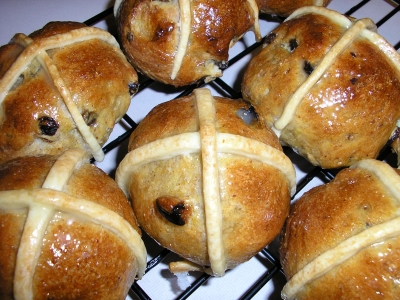
Hot cross buns are an Easter tradition I had never tried before, preferring to stick to the equally traditional chocolate (while avoiding frightening things like Peeps). But in the weeks approaching Easter, various food blogs and forums I read were full of hot cross buns and terrifying recipe ideas for Peeps and suddenly the hot cross buns looked fairly attractive. I saw a lot of unpleasant attempts with melty-looking frosting crosses, but quickly found a more traditional pastry-crossed recipe at A Spoonful of Sugar.

I knew the buns were pagan in origin -- isn't it fun how traditions like these, and Christmas trees, have shifted so we can still practice them thousands (?) of years later? -- but learned during my recipe search that they were originally meant to symbolise the sun, quartered to represent the four seasons.

They were fairly easy to make. The most time-consuming part was cutting the pastry and attaching it to the buns. The dough was supposed to take candied citrus peel, but I didn't have any and just used an equal amount of lemon and orange zest. I was probably more generous with spices than the recipe was (even though it claims to be 'extra spicy'), and just like the original blogger said, I didn't end up using all the milk the recipe called for. I'll post the recipe with the American measurements I used, but the original has the metric.

Extra Spicy Hot Cross Buns
Recipe (paraphrased) from Linda Collister, Bread

makes 12

3 1/4 cups unbleached strong white bread flour
1/3 cup stoneground wholemeal bread flour
1/4 cup granulated sugar
1 teaspoon sea salt
1 teaspoon ground mixed spice (I just tossed in a bunch of cinnamon and cloves and allspice)
1/2 teaspoon freshly grated nutmeg
3 1/2 tablespoons unsalted butter, diced
1/3 cup currants
1/4 cup raisins
1/4 cup citrus peel (about 1/2 lemon, 2 oranges)
1 package instant yeast
3/4 cup room temperature milk (This is how much I used, the recipe calls for about 1 cup)
1 large egg, beaten
Optional one cup of hot tea

pastry cross
1/2 cup all purpose flour
2 tablespoons unsalted butter, diced
2 teaspoons powdered sugar

glaze
4 tablespoons milk
3 tablespoons powdered sugar

Cover the raisins and currants with hot black tea and let plump.

Put the flours, yeast, sugar, salt and spices in a large bowl and mix well.

Add the diced butter and rub into the flour using the tips of your fingers until the mixture looks like fine crumbs.

Mix in the dried fruit (sans tea) and mixed peel, then make a well in the centre of the mixture.

Add the beaten egg to the well and approximately half the milk. Gradually draw in the flour to make a soft but not sticky dough. Add more milk if necessary , or extra flour (a tablespoon at a time) if the dough is too sticky.

Turn the dough onto a lightly floured work surface and knead throughly for 10 minutes.

Return the dough to the bowl and cover with plastic wrap. Let rise in a warm spot in the kitchen until doubled in size, about 1 1/2 hours.

Punch down the risen dough a couple of times to deflate.

Divide the dough into 12 equal pieces. Shape each into a neat ball and set well apart on a baking sheet. Cover with plastic wrap and let rise as before until doubled in size, 45 minutes - 1 hour.

Preheat the oven to 400*F.

To make the pastry for the cross, put the flour, butter and sugar into a small bowl and rub the butter into the flour with the tips of your fingers until the mixture looks like coarse crumbs. Stir in 1-2 tablespoons cold water to make a firm dough. Roll the dough out thin on a floured work surface, then cut into thin strips long enough to go over the rolls.

Uncover the risen buns, brush the pastry strips with a little water to dampen, then arrange, sticky side down, in a cross on top of the buns.

Bake in the preheated oven for 15-20 minutes until golden brown.

Meanwhile, to prepare the sticky glaze, heat the milk and sugar in a small pan until dissolved, then boil for 1 minute until syrupy.

As soon as the buns are cooked, lift them out onto a cooling rack and brush immediately with the hot glaze. (Place a tea towel (or wax paper, suggests TFB) under the rack to catch the drips!)

Eat warm or toasted, or freeze for up to 1 month.

Monday, April 10, 2006

Turkish Coffee Rolls

coffee

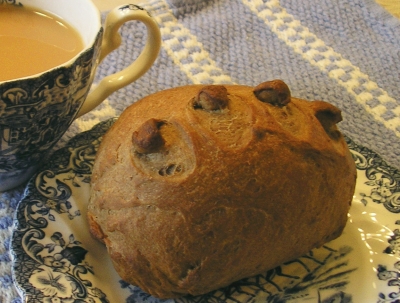
Black as hell, strong as death, and sweet as love? Well, not quite, but that's what I was going for. A while ago I got some Turkish ground (very fine grind) coffee to use in baking, most specifically to try to make coffee chocolate chip muffins that were better than the ones I had a recipe for. It worked perfectly. Using coffee beans ground to a powder in baking gives a stronger, richer coffee flavor than using brewed coffee or instant coffee granules, the two methods of adding coffee flavor I see most frequently. It's easy enough to buy an eighth or a quarter pound of beans ground like this for use in cooking (The Foppish Baker likes espresso or French roasts) -- the only problem is that most recipes will only take a tablespoon or so of the coffee, and the rest might go stale. Clearly having a grinder at home is the way to go.

In hopes of using up the coffee before it went stale, I made the muffins twice and also tried making a 'pain au lait au café', as I called it. I used a recipe for pain au lait, but added a teaspoon of Turkish ground coffee to a cup of milk, warmed it a bit to absorb the coffee more, and added that to the dough. It was nice, but I thought it could have been stronger. (Though honestly, I think my family prefer the more subtle flavor, but they're not coffee drinkers.) So this got me thinking about Turkish coffee and how good it is with cardamom, and why, oh why isn't the restaurant that makes it really well closer to my home?

So, I decided to try the coffee pain au lait again, this time with caradmom and a lot more coffee. The first bite tasted too salty, but I liked it more the more I ate. (This is a bit dangerous...) It doesn't exactly taste too strong, but it goes well with something creamy to balance it out, like butter, or Devon cream maybe.

Turkish Coffee Rolls

4 cups flour
1 package instant yeast
1/4 cup sugar
1 teaspoon salt
1 cup milk
1 egg
8 tablespoons butter, at room temperature
10 pods cardamom, shelled and crushed
2 tablespoons Turkish ground coffee
1 egg + 1 tablespoon water for egg wash

Add the milk slowly to the coffee and cardamom in a small saucepan, stirring well, and heat to about 115* F.

Mix the flour, salt, sugar, and yeast in a bowl, then add the milk and stir with your hand for five minutes. Add the egg and stir for another 5 minutes, then stir in the butter and let rest at room temperature covered with plastic wrap for one hour, or until doubled.

Degas the dough, cover again with plastic wrap and refrigerate for four hours or more.

Remove the dough from the refrigerator and let it sit out for an hour to return to room temperature, then shape into rolls.

(It looks like the traditional shape is a sort of mini-bâtard, without scores in it, but some Japanese sites I looked at for recipes had used a pair of scissors to make a row of little spikes in the dough. Mine didn't turn out nearly as cute as some of the pictures I saw, but I do like the look.)

Brush with egg wash (or don't, I completely forgot about it myself), let rise one hour, then bake 15~20 minutes at 400*F.