Thursday, May 18, 2006

Neapolitan Bread

neapolitan1

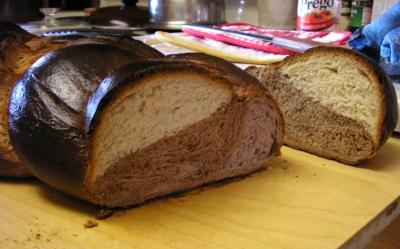
This has nothing to do with Naples; it's a bread version of the ice cream (which I think is a weird take on spumoni?). It's also evidence I am a genius, with a little help from Cam and my sister. This bread is fantastic.

Cam came up with the idea of a neapolitan bread and mentioned it in the comments of my blueberry fougasse post. We then kicked the idea around, figuring out the details of how to best make it, and this afternoon I finally went ahead and baked some off.

(Also, to protect my foodie street cred, I must point out that that isn't my Prego tomato sauce in the background.)

I used the Japanese sweet bread recipe for basic proportions of ingredients, but adjusted them so I wouldn't have to deal with 5/8ths of a cup of anything. I made the dough all together, then split it into three pieces, added flavours, and followed my sister's suggestion of doing a braid for the shaping. I had been thinking of either a swirl or doing three lumps side-by-side in a loaf pan so it would look like the ice cream.

neapolitan2

Isn't that pretty? I'm so pleased with it. It's also delicious (especially the vanilla parts). The strawberry isn't as flavourful as it could be, but I'm beginning to suspect that's what happens with fruit breads. Freeze-dried strawberries ground to a powder might work well though. Here is the recipe I used. Be warned, it makes a giant loaf.

Neapolitan Bread
Recipe by the Foppish Baker

4 teaspoons yeast
1 2/3 cups warm water
5 cups bread flour
3/4 cup sugar
1 1/2 teaspoons salt
4 teaspoons milk
2 eggs
5 tablespoons butter, softened

For the vanilla dough
Seeds scraped from two vanilla beans
1 teaspoon vanilla extract
1 teaspoon flour

For the chocolate dough
1 1/2 tablespoons cocoa powder
1 tablespoon water

For the strawberry dough
1 cup frozen strawberries, defrosted
1 cup flour

Egg wash
One egg, beaten
One tablespoon water

Dissolve the yeast in the warm water and let sit 5-10 minutes. Stir in two cups of the flour, then add the sugar and salt. Add two more cups of flour, then add the milk and eggs. Knead in the final cup of flour and the butter. You may need to add a bit more flour to make a dough that is manageable, but slightly sticky.

Divide the dough into three sections: two that are about 2/5ths the total, and one that is about 1/5th.

For the vanilla: Stir the vanilla beans, vanilla extract, and flour together into a paste then knead this into one of the larger portions of dough. It takes a long time to work it through evenly. Add more flour if needed to make a smooth and tacky, but not sticky, dough.

For the chocolate: Form a paste of the cocoa and water, then knead this into the other large portion of dough. This also takes a while. Add more water or flour if necessary.

For the strawberry: Defrost one cup of frozen strawberries. Pour them and their liquid into a large bowl and use your hands to squish them into a sort of lazy man's puree. This leads to there being some strawberry chunks in the dough, like all the best strawberry ice creams have. Plus it saves washing the food processor. Cut the smaller portion of the original dough into six pieces and mix them and one cup of flour into the strawberries. Add more flour and knead to form a dough of the same consistency as the other two.

Let all three doughs rise in separate, oiled bowls covered with plastic wrap for about two hours, or until about one and a half times their original size.

Degas the dough and roll out into ropes. Braid these together on a baking pan lined with parchment paper. Let rise for 45 minutes, or until it has increased about one and a half times.

Brush with egg wash.

Preheat the oven to 400*F and bake for 20 minutes, or until dark brown. Lower the temperature to 350*F and bake an additional 30 minutes, until it sounds hollow, rotating halfway through for even baking.

Let cool on a rack, slice, enjoy.

Tuesday, May 16, 2006

Pumpkin Muffins with Cinnamon Frosting

pumpkin-muffin

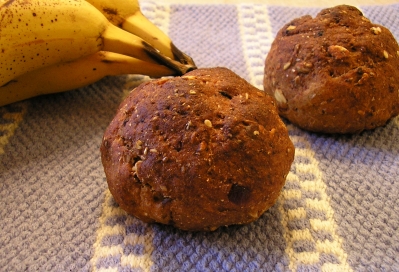
I hadn't planned on putting these on the blog when I made them. I usually don't bother writing about muffins or cakes because I don't find them all that interesting, and anyone can make them fairly well. There's just not a lot to share about the process. You will also never see cookies on this blog, but that's because I bake terrible (well, on the low side of average) cookies. Even following the same recipe, my mom's or sister's will turn out better than mine.

But I made an exception for these muffins because we happened to be eating some when my sister told me she'd given my blog address to some of her co-workers who had eaten some of my leftover bread once. She said they'd asked if there was anything easy on the blog. I said I didn't put easy things up because they're boring, but my mom flattered me into doing it by telling me the taste and texture of the muffins were 'phenomenal'.

To keep up the level of pretension I've come to expect from my blog, I left my highly sophisticated and fancy magazine in the photo. I think I should try taking pictures in the late afternoon more often, because I really like the lighting on this. And now, without further ado, the recipe...

Pumpkin Muffins with Cinnamon Frosting

Muffin batter
1 1/2 cups brown sugar
2/3 cup butter, softened
1 can pumpkin (I believe it's 12oz, and equal to 1 1/2 cups pumpkin puree.)
4oz sour cream (One half the smaller containers -- the other half goes in the frosting.)
2 eggs
1 tablespoon vanilla extract
1 tablespoon cinnamon
1/2 tablespoon nutmeg
1/2 tablespoon ground cloves
A 2 inch piece of ginger, grated
1/2 cup milk
3 1/2 cups all purpose flour
1/2 tablespoon baking powder
1/4 teaspoon baking soda
1 teaspoon salt

Measure out the brown sugar in a large bowl. Stir in the softened or melted butter. (A less lazy person might cream the two together, but I don't find it makes a huge difference, and like to save on dishes later by using one spoon for the whole thing.) Add the can of pumpkin and half container of sour cream. Add the eggs, vanilla extract and spices.

In a separate bowl, stir together the flour, baking powder, baking soda, and salt. Gradually add this to the other ingredients. Add milk as needed. The batter will be quite a bit stiffer than most muffin batters, but it turns out really dense and moist. I think I ended up using about 1/3 cup of milk in mine. More milk should give you lighter, fluffier muffins that rise more, and less milk will give you dense and flavourful muffins.

Line muffin tins and fill nearly to the top. Bake in a 350*F oven for 37 minutes.

Frosting
3 oz cream cheese, softened (I used a little package of cream cheese my mom says is 3 oz, but it looks about the size of half a normal package, which is 8 oz. But it's just frosting so it really doesn't matter how much you use.)
4 oz sour cream
1/2 tablespoon vanilla extract
1/4 cup powdered sugar
1 tablespoon cinnamon

Put the ingredients in a small bowl and mix with an electric mixer. Adjust cinnamon and sugar to taste. Adjust the vanilla extract for the consistency. I honestly don't remember how much of any of these things I put in...

Monday, May 08, 2006

Pain Aux Pommes

pommes

Two weeks in the making, this is the bread I mentioned in my post about the blueberry fougasse that is made on a starter of fermented apples. It was the first time I had ever fermented anything (on purpose) and I was excited about that (though the actual process mostly involves a lot of waiting) and I like the idea of starting bread on fermented fruit. I'd never heard of that, and it is definitely an idea that merits more attention and experimentation. Just think of everything that's been fermented to wonderful effect, and how many breads that could mean!

The bread also has a very nice texture and flavor. It uses a ratio of 1 part rye flour to 3 parts white flour, which gives the bread a more rustic taste that goes better with the apples than an all white flour bread would.

Making it was fairly straightforward, with only a few problems, all of which I was able to correct. They just seemed worse than usual because it would take more than a week to start over, if I ruined it. There was also very little explanation in the recipe of what the apples and dough should look or smell like at various stages. I also ended up adding some sourdough starter at the second refresh because I was worried it hadn't risen enough. This probably changes the flavor of the bread, but I had been stupid earlier and had to correct it. See, the recipe calls for organic, unbleached flour to be added to the fermented apple paste to make the starter. I was out of flour and all I had was bleached all-purpose thanks to someone's picking up the wrong thing at the grocery store. Bleached APF is very bad for sourdough, to say the least.

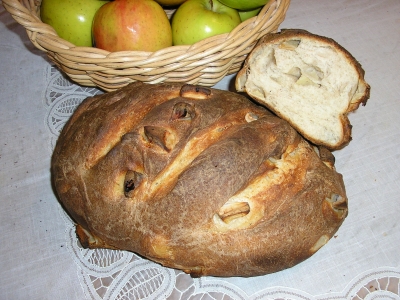
But everything worked out anyway, without more problems until I was baking. The recipe makes four (one pound?) loaves, which I shaped into one large and two small bâtards. I thought the sheets I'd put them on would fit on a rack in the oven side-by-side, but they didn't and I had to overlap them a bit. This probably did very bad things to the airflow and the bread burnt on top. It only cooked about half as long as the recipe said, but it was cooked through and delicious, if one overlooked the slightly blackened parts on the bottom and top. Pictured is the larger loaf that didn't burn much and one of the smaller ones ripped open to show the apples inside.

Pain Aux Pommes
Paraphrased from The Village Baker by Joe Ortiz
(This book is full of interesting recipes, but a photo of this one caught my eye and I was fascinated by the idea.)

The Levain de pomme
1 medium-sized apple peeled and cut into pieces (I think I used a Cortland or Fuji.)
3 tablespoons sugar
2 tablespoons water

Combine the ingredients and let them sit in a warm place for 8-10 days. When the mixture has become highly alcoholic and carbonic gas starts to develop, it is ready to use. (I kept mine in a Tupperware. After about three days, the lid would frequently swell up from CO2, so I'd let it out. It smelled very alcoholic after about 5 days, but I left it for 8.)
If any mold or fungus has developed on the apple mixture, carefully remove it. This should leave at least three-quarters of the mixture (1/2 cup). (I had no problems with this. One apple chunk turned slightly brown and I took it out, but the rest were fine.)

The first refreshment
1 teaspoon malt extract or 2 teaspoons honey (I used honey.)
1/3 to 1/2 cup warm water
1/2 cup apple starter from the previous step
2 cups organic, unbleached white flour (Seriously! Accept no substitutes)

For the first refreshment: Dissolve the malt extract or honey in the water. Mash the pieces of apple to a paste (I tossed everything in a food processor to do this, since a fork wasn't working.) and add the paste to the honey mixture. Add flour gradually while mixing with a wooden spoon. When the dough comes together, empty it onto the worktable and knead in the rest of the flour. Continue kneading into a firm dough for between 8 and 10 minutes. Place in a bowl covered with a damp dishtowel in a very warm place for between 8 and 10 hours. If it looks spotchy and spooky, throw it out and start over. If it looks round and well-risen, it is ready to be refreshed. (I put mine in a slightly warm oven for 8 hours, and it came out somewhere between 'splotchy and spooky' and 'well-risen'. I didn't particularly want to start over, so I added some sourdough starter.)

The second refreshment
1 teaspoon malt extract or 1 teaspoon honey
Approximately 1/3 cup water
All of the levain from the previous step
1 cup organic, unbleached white flour

For the second refreshment: Dissolve the honey in the water. Break up the levain in a bowl and pour the honey-water over it. Start adding flour gradually while mixing. (Here, I added maybe half a cup of starter and enough good flour (which I'd purchased by then) to make the consistency I expected they wanted.) Mix into a firm dough that is not too dry. Let this refreshed levain fermente between three and five hours in a bowl covered with a damp cloth. It should double in size. (Yep, the sourdough saved it...)

The dough
1 pound tart Granny Smith or Gravenstein apples (4 cups cubed) (I think it was 3 apples?)
3-4 tablespoons butter for sauteeing the apples
1 package active dry yeast (I cut this down to one teaspoon, because of my addition of sourdough starter)
1 1/2 cups warm water
1 teaspoon malt extract or honey
3 cups organic, unbleached white flour
1 cup organic rye flour
1 tablespoon salt
All of the levain de pomme from the previous step

Glaze: 1 egg white beaten with 1/2 cup cold water. (I skipped this. I am becoming less and less a fan of glazes and washes.)

To make the dough: Begin by preparing the apples. Peel, core, and cut them into 1/2 inch pieces. Saute them in the butter for a few minutes until they have softened. Set aside.

Proof the yeast in a little warm water and, when it is creamy, add it and the honey to the rest of the water in a large bowl. Cut the levain into pieces and add it to the liquid. Combine the salt and the two flours, then start adding the dry mixture to the liquid by handfuls, while mixing with a spoon. After you have added several handfuls of flour, you will need to stir the spongy mixture vigorously to dissolve the levain and make sure it is incorporated. Continue adding flour until the dough has come together. Turn the dough out onto a floured surface and knead in the sauteed apples and remaining flour. Knead the dough to a firm consistency with the rest of the flour. (This is a difficult task. My dough remained a bit on the sticky side when I decided it was 'done'.)

Set the dough aside, covered and in a warm place to rise for 1 1/4 hours, until doubled in size.

Cut the dough into 4 pieces and form each into a bâtard or a boule. Place the loaves on a parchment-lined baking sheet and let rise an additional 45 minutes to one hour.

Glaze the loaves (if desired) and slash with a blade.

Bake in an oven preheated to 425* or 450*F, either on the baking sheets or on a baking stone, for between 35 and 40 minutes. For the last 15 minutes of baking, reduce the temperature to between 375* and 400*F.

Note to the advanced baker: You may wish to reduce the amount of yeast to one teaspoon and extend the rising times to give more of a sourdough effect. You can also save a cup of the final dough and let that rise 8 hours if you wish to make the bread again the next day. Take that piece of dough from the 'second refreshment' step to make another batch.

Saturday, May 06, 2006

Stout Chocolate Cherry Bread

stout-choc-cherry

Lee mentioned this recipe in a comment on an earlier post, and I got it from her when we made banh mi together last week. The sandwiches were delicious, thanks to a hot dipping sauce we made (I forget the book the recipe was in, but hopefully Lee will post something on this?) and a huge variety of real Vietnamese pork products! Unfortunately, the bread didn't turn out, and I learned that glutenous rice flour is not what you want to use to make them. (At least, I assume that's why they failed.) That's the third time I've tried that recipe, and it's been nothing but trouble. Next time, I'm mixing rice flour and white flour together in advance and using that mixture in a more reliable baguette recipe.

But on to the current project, which I actually baked on Monday. (I've just been busy with work and sleeping and my latest internet addiction, LibraryThing, where you can catalogue all your books online. I discovered I have three more cookbooks than I thought, and also have something like five copies of Treasure Island.) I was excited to try this stout bread, first because most of the beer breads I've had in the past have been cakier -- more like quickbreads -- and because this called for the stout to be used in making a sponge that is refrigerated overnight, which I think accounts for the incredibly delcious stout flavour in this.

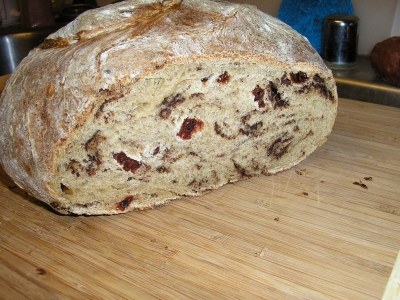
I used my last bottle of New Glarus Brewing Company's limited edition Cherry Stout to make the bread. It was well worth it. It's a great beer to drink and it makes a fine bread, with both the cherry and stout flavours clearly present. I also used cherries from Door County, Wisconsin, so if only we produced chocolate (or flour), it could have been a very local bread. For the chocolate, I chopped up a bar of Lindt 85% (my eating chocolate of choice) because the bittersweet chocolate I bought contained milk, and my sister wanted to eat the bread too. The chocolate was overpowering, even though I used half the amount the recipe called for. Bittersweet is definitely a better idea. I tried my 'g' slash on the loaf again, but it was not as successful as my first, so it's not featured in the photo.

I was surprised this recipe came from a healthy cooking magazine (I forget which... Lee?) because stout, chocolate, and dried cherries do not a healthy diet make. But there's not much sugar in the bread, and no fat, and I think I remember the recipe's calorie count being in the neighbourhood of 150 calories a slice. More importantly, it is delicious. If I made it again, I would probably bake it at a higher temperature and do the whole hearth baking thing for a nice, thick crust. Following the recipe makes you the thin, soft crust Americans prefer. I might also like to try this with Wisconsin Belgian Red in place of the stout, leave out the chocolate, and just do cherries. Of course, the beer and ingredient possibilities are endless...

Stout Chocolate Cherry Bread
Paraphrased from [source]

4 1/2 cups bread flour
1 12oz bottle stout
1 package dry yeast
1 tablespoon sugar
1 teaspoon salt
1/2 cup dried cherries
4 oz bitterswet chocolate (I used half this amount)

spray oil
1 teaspoon water
1 egg white
1 teaspoon pearl sugar

Stir two cups of the flour, the stout, and yeast in a bowl, cover and refrigerate overnight.

Remove from the refrigerator and let stand at room temperature for one hour.

Add the sugar, salt, and as much of the remaining flour as is needed to make a firm dough. (Lee's notes had it needing much less flour than the recipe called for; I used it all.) Knead until smooth and elastic. Add more flour or water, if needed to correct the dough, then knead in the cherries and chocolate.

Put the dough in an oiled bowl, cover, and let rise for one hour in a warm spot.

Degas the dough and let it rest five minutes. Shape into a boule on a pan covered with parchment paper. Spray with oil and let rise one hour, until doubled in size.

Preheat the oven to 350*F. Mix the egg white and water together and brush this mixture over the boule, sprinkle with pearl sugar if desired. (I skipped this entirely. -tfb)

Bake 30 minutes, or until browned and the loaf sounds hollow on the bottom.